Elo
The Elo rating system was originally developed to rank chess players. It has since been adapted and widely used to evaluate computer generated content based on pairwise comparisons [1, 2]. For instance, Elo scores have been used in the CLIC compression challenge to decide the ranking of image compression methods based on pairwise comparisons of images.
Underlying Elo scores is a probabilistic model of outcomes of pairwise comparisons. For competing methods and with Elo scores and , the probability that is preferred over is assumed to be:
Here, we use the notation "" to denote that was preferred over in a single pairwise comparison.
The standard algorithm for computing Elo scores is noisy and highly dependent on the order of ratings. Many research papers therefore report Elo scores averaged over thousands of random permutations of the data. Our platform instead implements a robust Bayesian inference algorithm for estimating Elo scores, which allows us to provide efficient live updates of Elo scores, along with uncertainty estimates. The scores are available on our platform in the results section of pairwise experiments. They are also computed for ACR, multi-ACR, rank, and MUSHRA experiments, where the ratings are first decomposed into weighted pairwise comparisons via a Plackett-Luce decomposition before the same inference is applied.
Vanilla Elo scores
Let represent the outcome of a pairwise comparison. For example, this could be the result of presenting two images to a human rater. If the image generated by method was preferred, , we set . If method was preferred, we set . The basic update rule for vanilla Elo scores is as follows:
This update rule can be viewed as a stochastic gradient step on the log-likelihood of Elo scores,
where the dataset consists of triplets and is the step width.
Due to the lower reliability of vanilla Elo scores, they are enabled on our platform only on request. We use and initialize Elo scores at , following previous applications of Elo to the evaluation of images [1]. For ties, we set . Vanilla Elo scores are updated once per pairwise comparison, which are processed in batches after a session completes.
Bayesian Elo scores
The probabilistic model underlying the Elo rating system is equivalent to the Bradley-Terry model [3]:
where the relationship between and Elo scores is
Note that the probabilities do not change if we add a constant to the Elo scores, or equivalently if we multiply the skill ratings by a constant factor.
Many methods for estimating the Bradley-Terry model have been proposed. Hunter [4], for example, proposed the MM algorithm corresponding to the update
where is the number of times method won against any other method, and is the number of times was compared to . Under a mild but technical condition, this algorithm is guaranteed to converge to the maximum likelihood estimate of the Bradley-Terry model [4].
Caron & Doucet [5] identified the above update as an expectation maximization (EM) algorithm. They further proposed placing a Gamma prior on the skill ratings with shape parameter and rate parameter , leading to the following modified update rule:
Instead of EM updates, we perform mean-field variational inference updates [6], which are nearly identical:
This update rule is used when computing the scores "Elo" on our platform. We use , , and so that in the absence of any data, and . These parameters correspond to the prior distribution over Elo scores visualized below.
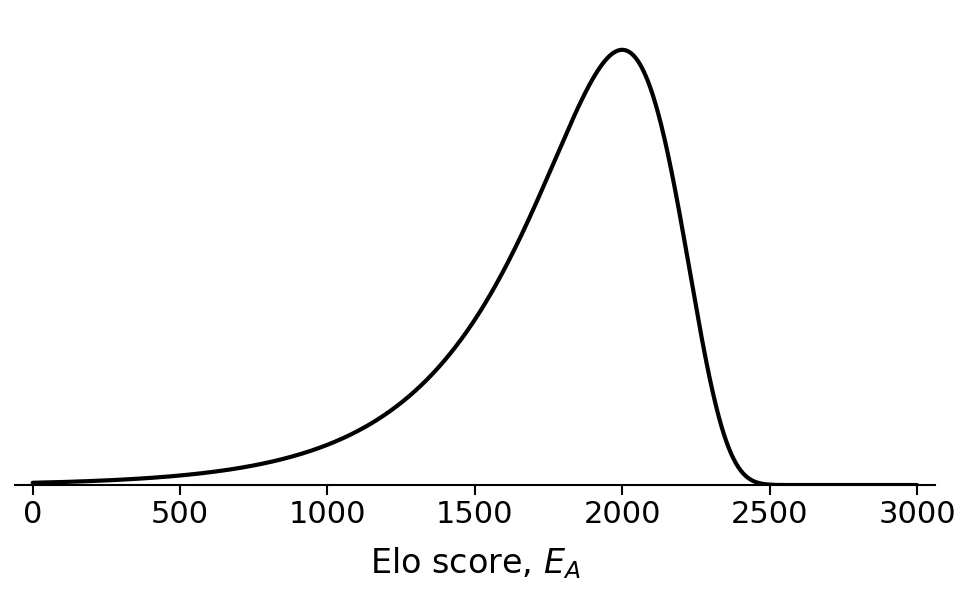
Unlike for vanilla Elo scores, we apply the update iteratively for up to 2 steps per pairwise comparison after every session that completes. Each step takes into account the entirety of the available data and updates all Elo scores.
Uncertainty estimates
The mean-field updates can be written as follows:
Here, and are the parameters of a Gamma distribution over the skill rating . The expected value of under this distribution is , which corresponds to our update rule above. Using this Gamma distribution, we compute 95% confidence intervals based on the 2.5th and 97.5th percentile.
References
[1] Mentzer et al. (2020). High-Fidelity Generative Image Compression.
[2] Askell et al. (2021). A General Language Assistant as a Laboratory for Alignment.
[3] Bradley, Terry, and Milton (1952). Rank Analysis of Incomplete Block Designs.
[4] Hunter (2004). MM algorithms for generalized Bradley–Terry models.
[5] Caron and Doucet (2010). Efficient Bayesian Inference for Generalized Bradley-Terry Models.
[6] Wainwright and Jordan (2008). Graphical Models, Exponential Families, and Variational Inference.