Real or not?
The binary audio experiment presents raters with a single audio clip and asks them to decide which of two categories it belongs to. By default, these categories are Real and Generated, but the labels can be customized.
This experiment is useful for discrimination tasks where you want to measure whether listeners can tell apart reference audio from synthetic or otherwise manipulated audio. In each trial, raters listen to one clip and choose between the two configured labels.
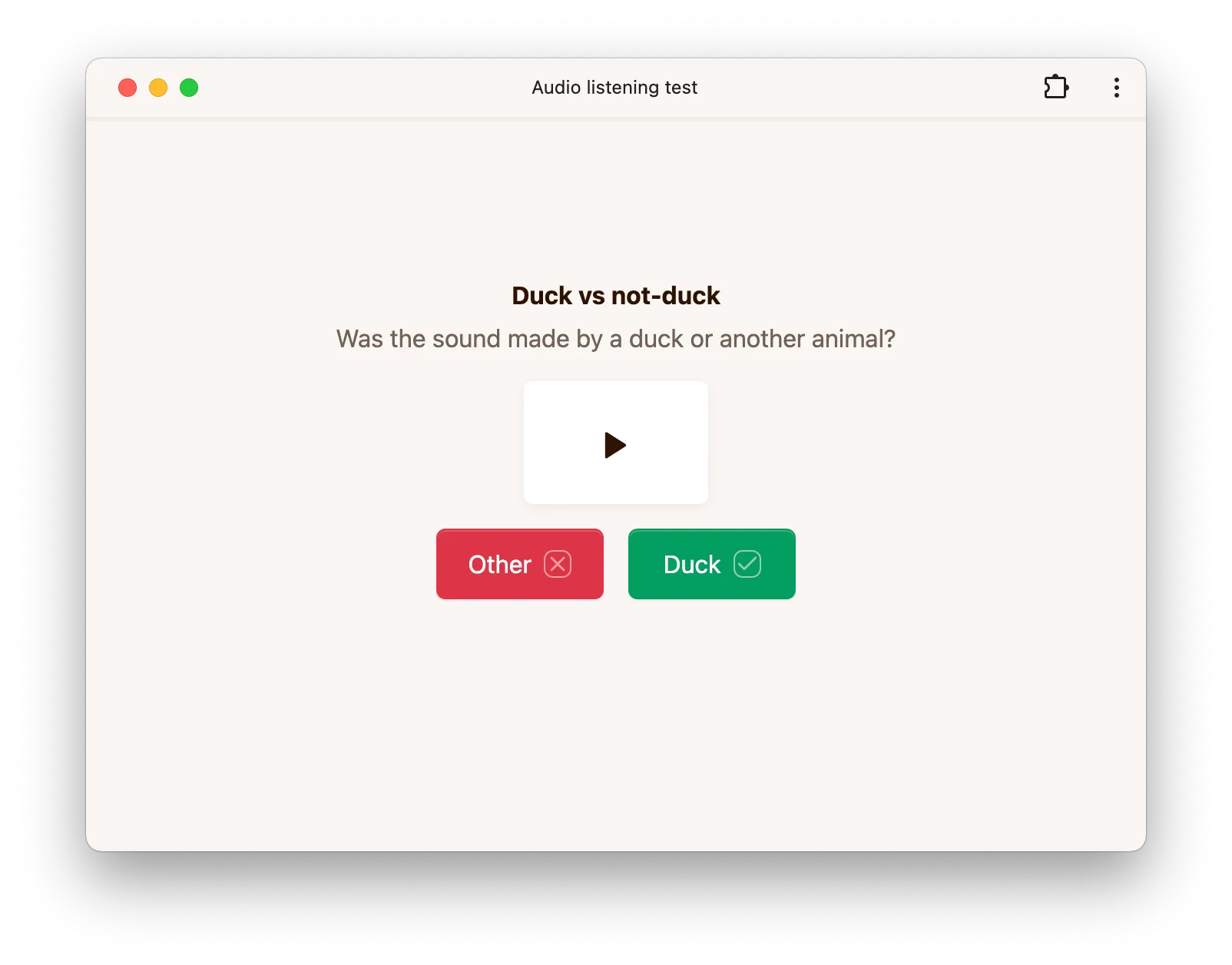
Categories
The two response labels are configurable. By default, the interface uses:
| Key | Label |
|---|---|
real | Real |
fake | Generated |
You can replace these with labels that better match your task, as long as there are still exactly two categories.
Options
Minimum play duration
This option controls the minimum duration (in milliseconds) for which the audio must be played before raters can submit their response.
Reference probability
This option controls how often a reference audio clip is shown instead of a non-reference clip. A
value of 0 means reference clips are never used, a value of 1 means only reference clips are
used, and 0.5 means reference and non-reference clips are shown equally often.
This is useful when the dataset contains reference audio and you want to measure how reliably raters can distinguish it from generated or manipulated examples.
Give feedback
If enabled, raters hear immediate audio feedback after each response indicating whether their decision was correct. The outro page also includes a per-question correctness table when feedback is enabled.
Configuration via API
Below is an example configuration to get you started when using our API to create a binary audio experiment.
config = {
    'binaryAudio': {
        'labels': {
            'real': 'Real',
            'fake': 'Generated',
        },
        'referenceProbability': 0.5,
        'giveFeedback': True,
        'minPlayDuration': 500,
    },
}